
The Western Monarch Remains in Serious Danger of Extinction
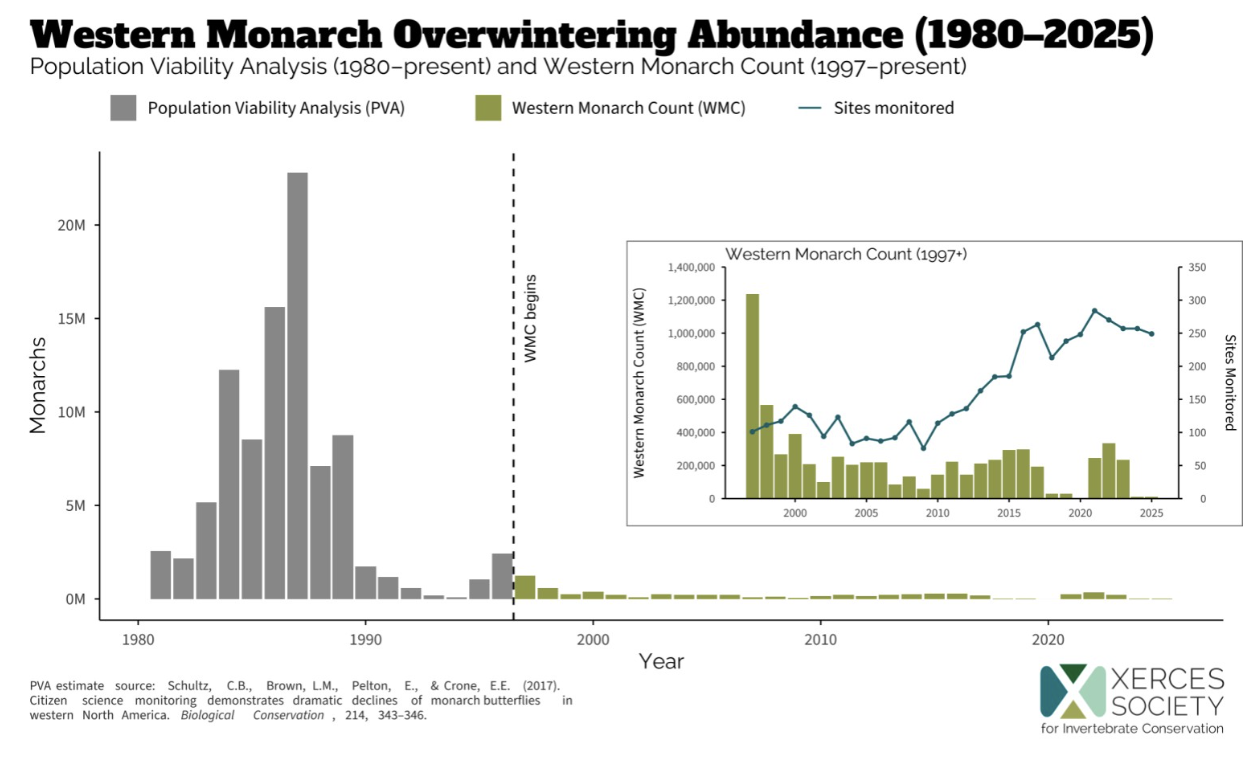
The results are in from the 29th annual Western Monarch count, led by the Xerces Society. From late November 2024 through early December 2025, hundreds of volunteers and partners surveyed 249 overwintering sites along the California coast from Mendocino County to Northern Baja in Mexico, as well as known inland sites in California and Arizona. The results showed a peak population of just 12,260 monarchs. While this is an increase from last year’s season it is the third-lowest tally since the count began in 1997. At that time, over 1,200,000 monarchs were reported. This report by the Xerces Society provides specific information about where the collection was performed and what was found at each site. The best showing was at Natural Bridges State Beach in Santa Cruz County, where 2,500 monarchs were counted.
The predictions for the western monarch are dire, with a 98% to 99% probability of extinction within 60 years.
The latest count of the eastern monarch overwintering population in Mexico shows a modest increase over last year’s numbers. However, the eastern monarch’s population remains low compared to that of previous decades. Estimates suggest that the eastern monarch population’s extinction probability ranges from 48% to 69% within the next 60 years.
Action is Needed at the Local, State, and National Level
“A lot of people care about monarchs. Voluntary efforts like pollinator gardens and restoring habitat are probably a reason they aren’t in worse shape. However, these actions are not enough. To help monarchs recover, we need to work at a larger scale and address widespread issues like pesticide contamination and climate change that are beyond what voluntary efforts have been able to achieve.”
Isis Howard, coordinator of the Western Monarch Count

Habitat loss particularly affects specialist species like the western monarch. As caterpillars, they are 100% reliant on milkweed to survive. As adults, they need nectar plants for sustenance. During the winter, they require roosting trees for protection from the wind and rain. Learn about efforts at the local and state level to restore critical monarch habitat.

Monarchs face danger from vertebrate animals as well as predatory insects. In this section, learn which natural predators are the biggest threat in Marin, and how to minimize the damage they cause.

Synthetic pesticides are harmful to butterflies and other pollinators. Neonicotinoids, pesticides once widely used in agriculture and landscaping, are among the most deadly. The herbicide glyphosate has come under serious scrutiny for its effects on human health. Also, learn why Integrated Pest Management is so important in Marin.